To take good notes in class, write key ideas in your own words instead of copying everything, use a structure that fits the lecture (Cornell, outline, mind map, chart or sentence method), mark what you don’t understand, and review the same day. A recording of the lecture, transcribed by an app like Mangonote, fills the gaps you couldn’t catch, so your notes can focus on understanding.
Here are the five methods, when each one works best, and a routine that ties them together.
1. The Cornell method
Split the page into three parts:
- Notes column (right, wide): what the lecturer says, as short phrases.
- Cue column (left, narrow): after class, write questions and keywords that match each part of your notes.
- Summary (bottom): two or three sentences in your own words.
Best for: most lectures and exam revision. Covering the notes column and answering the cue questions turns your notes into a quiz.
2. The outline method
Main topics on the left, subtopics and details indented below them:
- Photosynthesis
- Light-dependent reactions
- Happen in the thylakoid membranes
- Make ATP and NADPH; release oxygen
- Calvin cycle
- Happens in the stroma; fixes carbon dioxide into sugar
- Light-dependent reactions
Best for: well-organized lectures where the structure is clear, like a slide deck with headings.
3. Mind mapping
Put the main topic in the middle of the page and branch out to related ideas, with lines showing how they connect.
Best for: topics full of relationships, such as history, biology systems and literature themes. It’s also good for brainstorming an essay.
4. The charting method
Make a table with a column for each thing you compare and a row for each feature.
| Mitosis | Meiosis | |
|---|---|---|
| Cells made | Two | Four |
| Chromosomes | Same as the parent | Half |
| Purpose | Growth and repair | Sex cells, genetic variety |
Best for: comparisons, timelines, and lectures full of facts that fit categories.
5. The sentence method
Write each new idea as one short line, numbered, without worrying about structure.
Best for: fast lectures where you can’t see the structure yet. Reorganize it into one of the other formats when you review.
Tips that work with any method
- Listen for signals like “the key point is”, “this will be on the exam” or “there are three reasons”. Write those down.
- Use abbreviations you’ll still understand next week.
- Leave gaps and mark them with ? instead of falling behind.
- Copy examples, not just definitions. Examples are what make things click later.
- Review the same day. Fill gaps, write the summary, add cue questions.
Where recording the lecture fits
Your notes should be about understanding; a recording is about not missing anything. With permission from the lecturer, record the lecture in Mangonote: it’s transcribed on your iPhone, even with no signal in the lecture hall. After class, use the transcript to fill the gaps you marked with ?.
AI can then help with the cue column: a custom prompt like “Write ten review questions with answers from this lecture” or Ask AI with “Explain the part about the Calvin cycle more simply”.
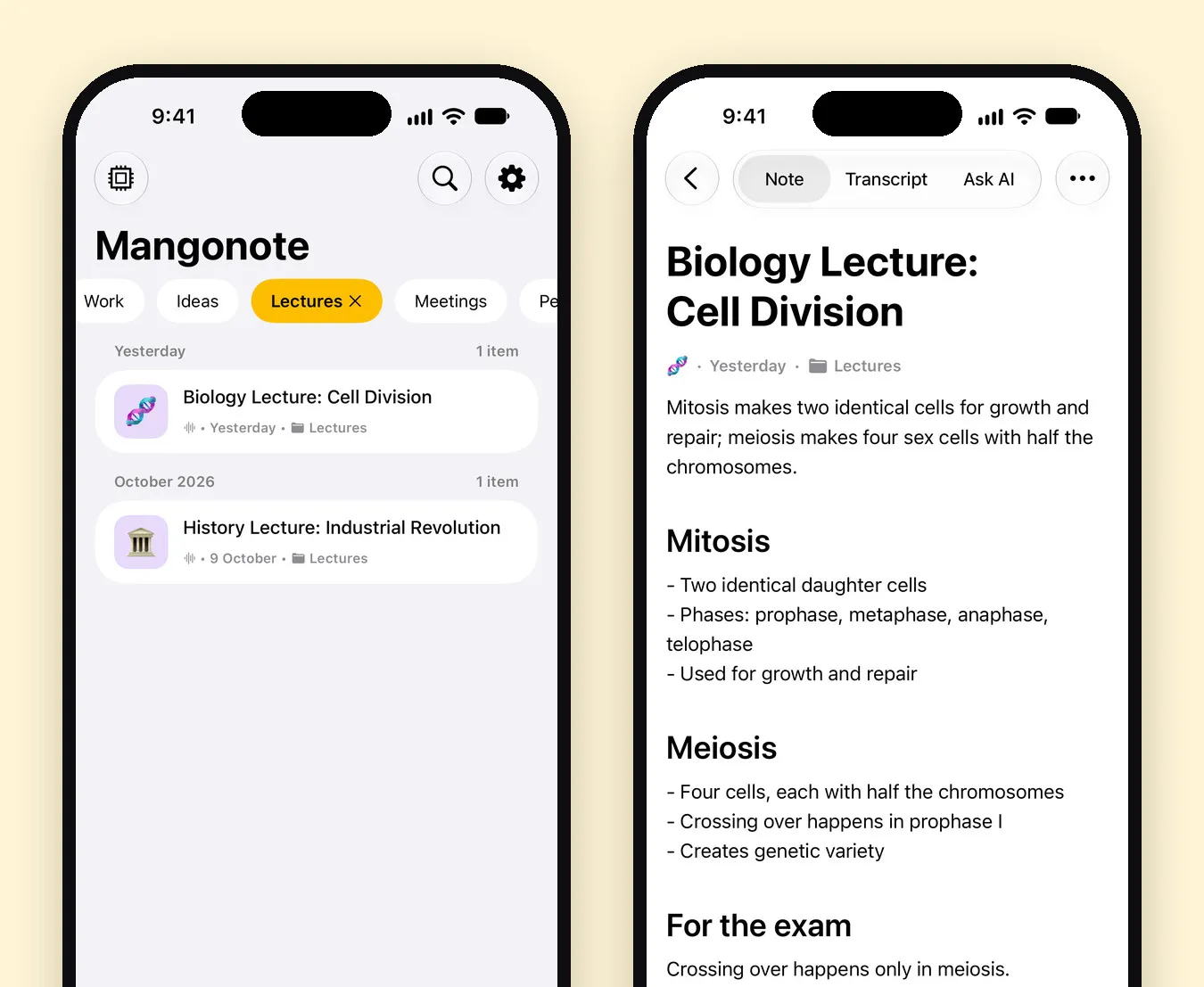
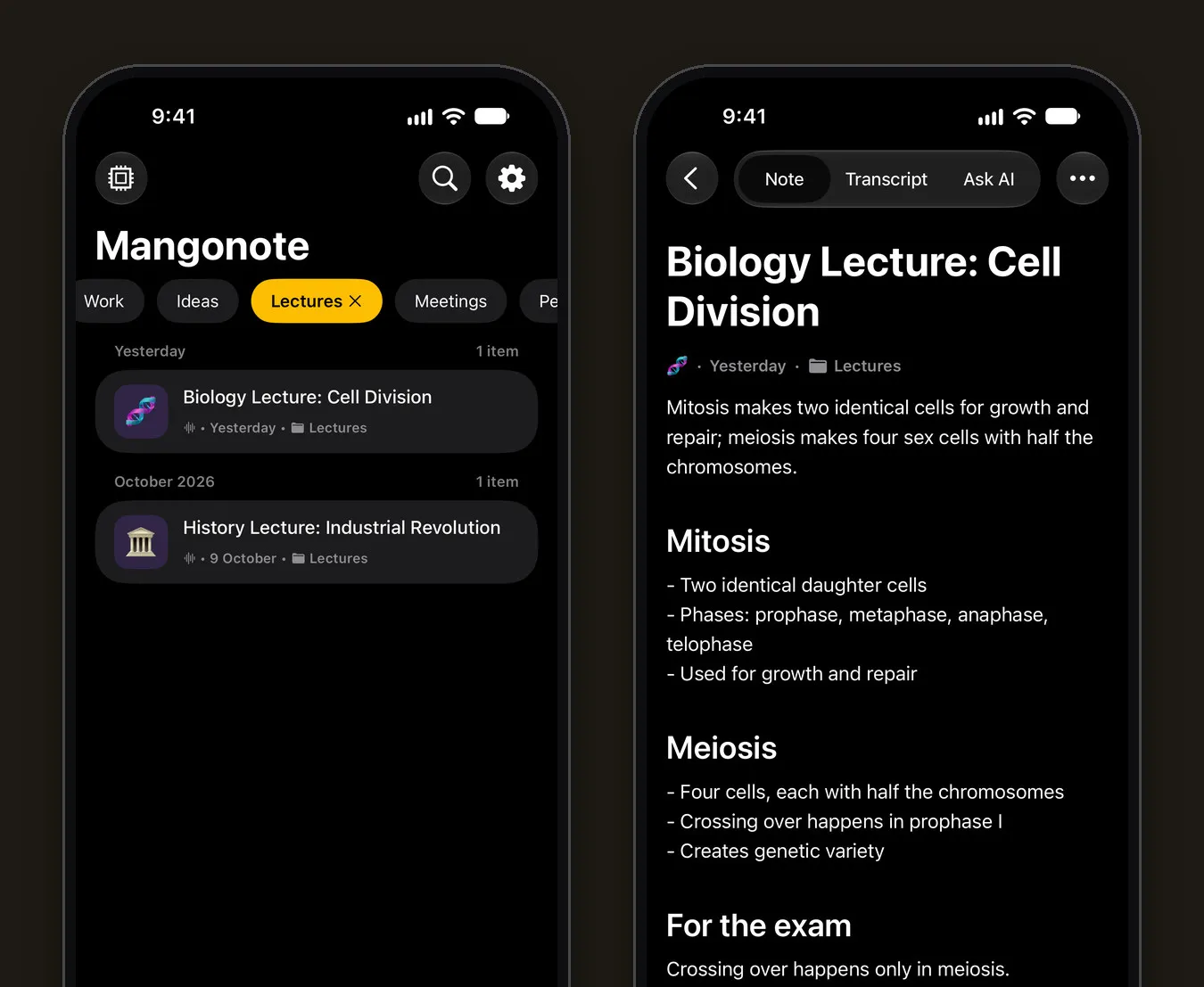
Keep one folder per course, and search finds the lecture that mentioned any term. Our full guide covers how to record lectures on iPhone and turn them into study notes.
A simple routine
- Before class: skim the slides or reading, and write the lecture’s main headings.
- In class: take notes with the method that fits; record if allowed.
- Same day: fill gaps from the transcript, write the summary, add cue questions.
- Each week: quiz yourself from the cue questions.
Related guides
- How to record lectures on iPhone and turn them into study notes
- Note-taking with ADHD or dyslexia: try voice first
- How to summarize a recording with AI
Frequently asked questions
What is the best note-taking method?
There isn't one best method. The Cornell method suits most lectures and revision; outlines suit well-structured lectures; mind maps suit topics full of connections; charts suit comparisons; the sentence method suits fast lectures where you can't see the structure yet.
How do you take notes in a fast lecture?
Write short phrases and key terms, not full sentences, leave gaps for what you missed, and fill them in after class from slides, the textbook or a recording of the lecture.
Should I record lectures instead of taking notes?
Use both. Writing makes you process the material; a recording catches what you missed. Ask your lecturer before recording.
How soon should I review my notes?
The same day if you can. Fill gaps, write the summary line, and turn key points into questions while the lecture is fresh.
Are digital or handwritten notes better?
Either works. What matters is that you put ideas in your own words and review them, not copy everything word for word.
Start capturing the thoughts you keep losing
Download Mangonote, record your first note, and watch it become searchable text in seconds, right on your iPhone.